About two years ago, my social media feeds were suddenly abuzz with the news of events around a children’s book on the Darjeeling Himalayan Railway, Baby Sivok, written by David Charlesworth, a UK-based railway enthusiast. The tiny engineering marvel of a railway has had a soft spot in my heart ever since my days at The Telegraph. As a cub reporter, I wrote so much about it that I almost turned it into a legit reporter’s beat. Many call it the “Toy Train,” which I think is wrong, given that it is anything but a toy: it is a living monument, recorded as a World Heritage Site by Unesco.
I chased DHR stories even as a freelancer afterwards. While at Oxford, I once landed up in the yard of the late Adrian Shooter in the village of Steeple Ashton village in the United Kingdom, just to admire his garden railway that the former director of Chiltern Railways had built with a DHR locomotive sourced from a museum in Chicago. I even went to Leighton Buzzard to see how the rail enthusiasts in the UK had converted one of their stations into an Indian station and indulged in vicarious pleasure by running steam rides using Shooter’s DHR locomotive. You have to read my stories here and here to know all about it.
So, it’s no surprise that I got really excited that someone had written a book for children on the DHR. And that too by someone whose love for steam and all things heritage runs really deep.
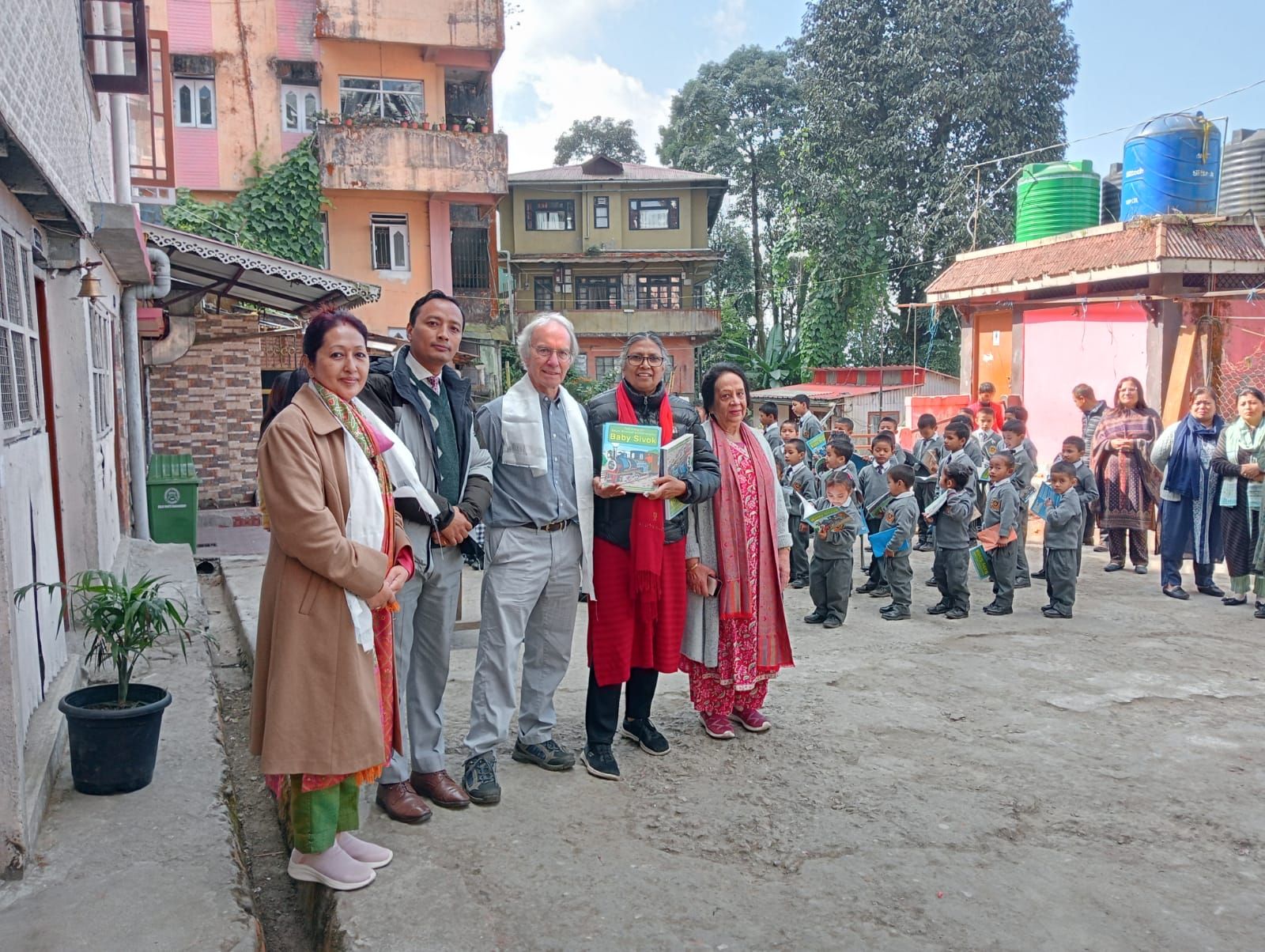
David Charlesworth is a UK-based artist who apparently began drawing recognisable trains and aircrafts “even before the age of three”. An artist, designer and huge enthusiast for transport history, he has spent much of his life documenting railways through paintings, illustrations and books. He’s also the founder member of Darjeeling Himalayan Railway Society. I have known him since my days at The Telegraph, I could fish out one story from 18 years ago in which i have quoted him. In fact, I recently found a story from eighteen years ago in which I had quoted him.
There’s a lot to say about his book and I shall do so in another post. That’s because its revised edition is now being published by Foothills Publishing, which is also my publisher. It will be launched soon, and I will tell you more about it then.
For now, let me share Charlesworth’s note remembering Siliguri. His reflections, that he shared with me over email, capture the town’s transformation from a sleepy rail hub to a bustling modern center. Must pay particular attention to the caveat in the end!
I love the “border town” feel of Siligiri
by David Charlesworth
My first visit to Siliguri was in December 1986; I knew very little about the area at that time, only Darjeeling and this was because my grandfather was there during the Second World War. As I was brought up by my grandparents we had books and photographs that he bought there in 1943. In fact The Oxford bookshop still exists and in the same building on Chowrasta where he bought two of the books I still have. As did most servicemen, DAS Studios, also in Darjeeling, is where he bought photographs showing the amazing DHR and its special locomotives. So I have known about the railway all my life, thus making my first visit very exciting but I wish I’d been better prepared.
This lifetime of awareness revitalised with many pleasant winter evenings of slide shows at the home of my friends Peter and Linda Jordan, is what finally brought me to India.
We arrived on a meter-gauge overnight sleeper train from Jayanagar on the Nepal border via Sakri Junction and Saharsa Junction, which I am sure come through Aluabari Road Junction and Naksalbari into Siliguri Junction from the North end, as I have no photographs or memory of New Jalpaiguri from that trip.
It was early December and the DHR still wasn’t running through trains because of landslides so we changed to a taxi. I have one photograph from Siliguri Junction and that is of a WD 2-8-2 steam engine of the type that is still plinthed outside New Jalpaiguri station. There was a lot of steam around in those days and that was one the main reasons for visiting India; to chase steam locomotives. The other reason was to see the town of Darjeeling that I had heard so much about.
I never saw Siliguri on this first trip, my first impression of the town proper was in 1999. I remember it made me feel like a true adventurer as it was very dark. Street lighting was minimal and there were very few taxis, it was mostly Auto Rickshaws. The town was nothing like the size it is today; no super shopping malls and very few hotels of the standards we see now. Sevoke Road for example, is unrecognisable in comparison.
At the start of the 20th Century, Siliguri was still a village with a population of just over 750. Its importance began with the coming of the Eastern Bengal Railway in 1878 and the transfer of the Deputy Magistrate’s headquarters from Hansquar, near Phansidewa in 1881 (O’Malley,1907). The railways often changed the importance of a village or town, indeed, many towns were created just because of the railways; something that is particularly common in the UK where it has left a vast number railway towns devoid of purpose as the railway has now gone. The opening of the Darjeeling Himalayan Railway in 1880 secured the importance and growth of Siliguri.
Since then, Siliguri has continued to grow but a truly significant change has come about since COVID (2020). As a visitor able to come just once a year, I find a staggering difference each visit. Much of it appears good for the town (and indeed India) but as a visitor, the magic of the area is reduced.
I must have made around ten visits to Siliguri, and, apart from 1986, always staying at The Cindrella on Sevoke Road, as they have been good friends for over 25 years and I feel very much “at home” there.
I love the “border town” feel of Siligiri and how close it is to the wildlife parks and open countryside where you can be out of town in a few minutes by motorcycle. For me, the most exciting part is the railway history. Sadly, it has lost the opportunity to be one of the most interesting places on earth for railway enthusiasts: Steam on three gauges was a spectacular event in 2006. Now no longer possible through neglect and lack of understanding, it is a huge loss for the town. We now have to fight to preserve the immensely important memorial to the DHR, Siliguri Town, old station. The area is now in severe decline and having seen the station in use on the DHR side, it is distressing to visit what is now known as the “Siliguri Toilet”.
The new bypass cutting through the town is considered a good thing by many locals but as an outsider, the way it is cutting through with total disregard for its appearance and impact on the environment visually and the poorer businesses and families is sad to see. The new shopping malls are going to hit local traders harder than they can imagine – I have seen it in the UK.
 Anuradha Sharma