Mark Tully, the celebrated BBC journalist and one of the most perceptive chroniclers of India, died earlier this month. Long before he became synonymous with nuanced, empathetic reporting on the country, Tully had already formed a personal bond with it, spending five formative years of his childhood in Darjeeling during the Second World War. I interviewed him in August 2004 (that’s twenty-two years ago now!) when he returned to north Bengal for a Unesco workshop on the Darjeeling Himalayan Railway, an institution deeply entwined with his early life. It was a brief interview, constrained by the realities of print journalism at the time, when stories were short, space was scarce, and conversations often had to be compressed into their most basic form. Looking back now, as I work primarily on longform narratives, this piece feels like a tiny bite rather than a full portrait. I wish I had been able to spend more time with him, to listen more closely to his memories of Darjeeling. Still, I hope this short account captures a small slice of a life shaped, in quiet but lasting ways, by the hills and the toy train that once carried him to school.
This story was first published in The Telegraph, August 2, 2004. As far as I remember, the print edition carried a photograph with this story. I haven’t been able to locate it now, so I’m sharing an image from Wikimedia Commons instead.
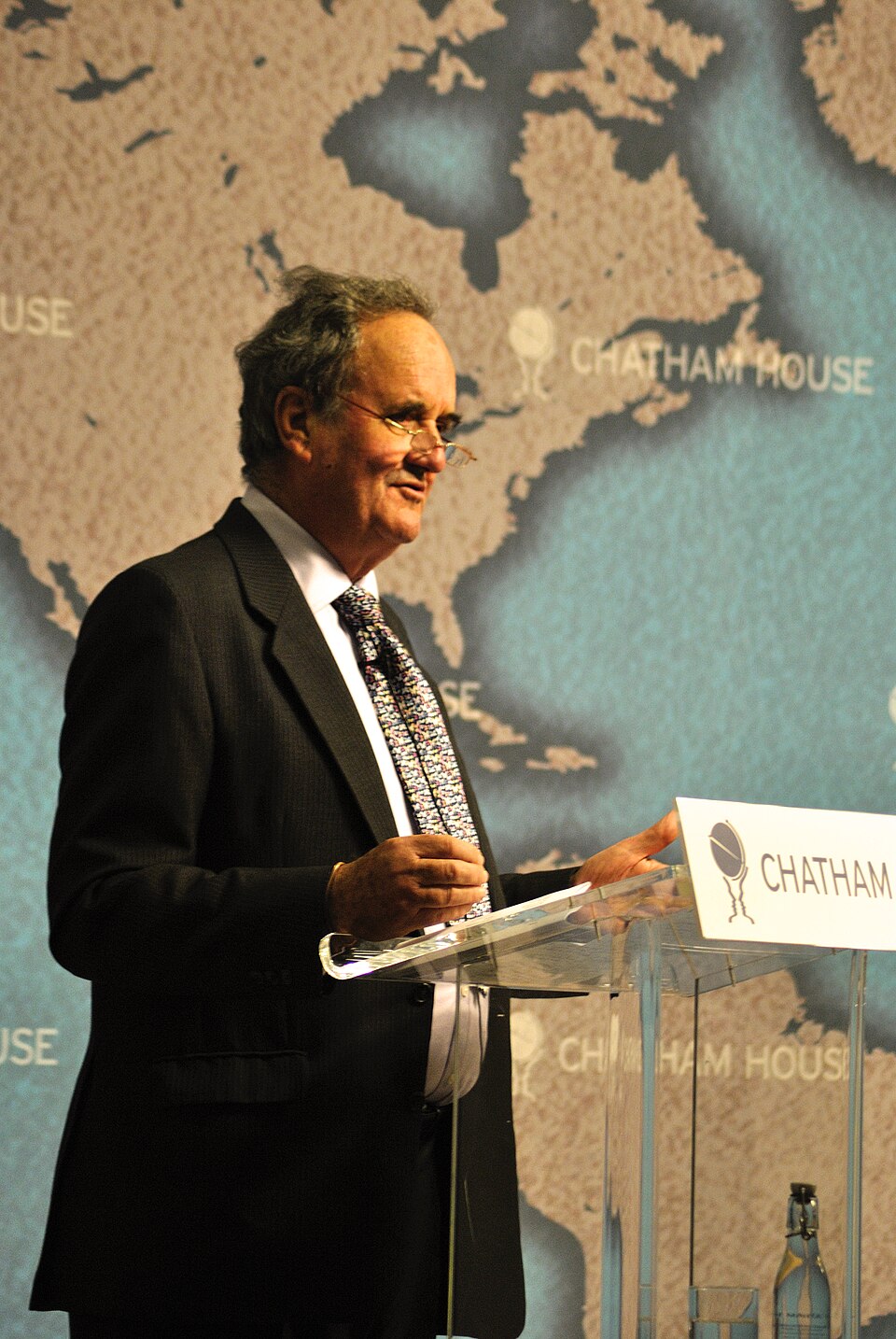
Sir Mark Tully, journalist and BBC correspondent. Photo: Chatham House / Wikimedia Commons
Tully on memory track in hills
Siliguri, Aug. 2: It was just five years of childhood spent in Darjeeling, but for BBC journalist and scholar Mark Tully, the short stay was instrumental in bonding him eternally to the hills, more so with the Darjeeling Himalayan Railway (DHR).
Coming all the way from Delhi, where he is currently based, to attend a two-day workshop on the DHR organised by the Unesco, Tully once again proved that his love for the toy train is deep-rooted.
“How can I ever forget the DHR? This was the train that ferried me to school daily,” said Tully, whose father William Tully worked as the director of DHR in the pre-Independence era.
“Since we could not go back to England because of the Second World War, we had to study here. At the age of four, I came to Darjeeling from Calcutta where I was born. I studied in New School, a special school for British people that existed during the war. I left for England after the war ended in 1945,” recalled the journalist who is a member of Friends of DHR.
“Even after I left, the memories of Darjeeling would haunt me. I had an uncle at a tea garden in the Dooars, through whom I tried to keep my hill town connection alive. In 1965, I visited Darjeeling on my first holiday,” he said.
What saddens Tully now is that the DHR is no longer the main public transport. “Motor transport, which I hate so much, has thrown up a challenge to the DHR. It is sad that the icon of Darjeeling stands threatened. However, there are some people who understand the train’s relation to the hills and is working towards promoting it as an icon of the hill town. I feel happy that there are so many of them the world over and they will be able to keep alive the reputation of the toy train,” said Tully. “I see a great future for the DHR.”
An active patron of the DHR, Tully is now busy promoting the toy train the world over. “DHR has been accorded the world heritage status and that has given Darjeeling a new identity. People across the globe are keen to know more about the DHR. Early this year, a steam engine festival was held in York in Britain. I had manned the DHR stall and it had drawn the maximum crowd. Around 70,000 people had visited the stall.”
“The toy train needs to be properly marketed. For a better promotion, it is necessary that the DHR is not thought of in isolation. There should be some kind of a package to market the entire area — its scenic beauty, Darjeeling tea and the ethnic people — with the DHR as the main attraction,” Tully said.
 Anuradha Sharma