Hill Cart Chronicles–Post #2
“When the rains started on a Saturday, we’d say it would last a week. If it began on a Tuesday, it would go on for three days.”
That’s how 90-year-old Suhas Basu of Subhash Pally described the monsoons of his youth. Back then, Siliguri saw two seasons, he said—rainy season and winter. Not this dry, drawn-out heat we’ve been dealing with. Not this scorched, airless version of July.
By his time, Siliguri wasn’t exactly a nondescript “village”—it was already a key transit point where tea and timber came down from the hills before heading out to the rest of the world. Every chest of the famed Darjeeling tea passed through here. It was an important place for business, no doubt. But it still looked and felt like a “village”—green, scattered, unhurried.
Then came more people, more shops, more roads, and many more cars. A town had to be built to hold them all. The weather changed too—quietly at first, and then with a speed no one was prepared for.
Hotter days, quieter clouds
This July, temperatures in Siliguri stayed consistently high. It could well be the hottest July in recorded history, though this would need further confirmation. On July 13, the town recorded a blistering 39.4°C, followed by 38°C on July 24. Daily data from Visual Crossing confirms that Siliguri breached the 38°C mark on multiple days this month—well above the usual July average of around 30.7°C.
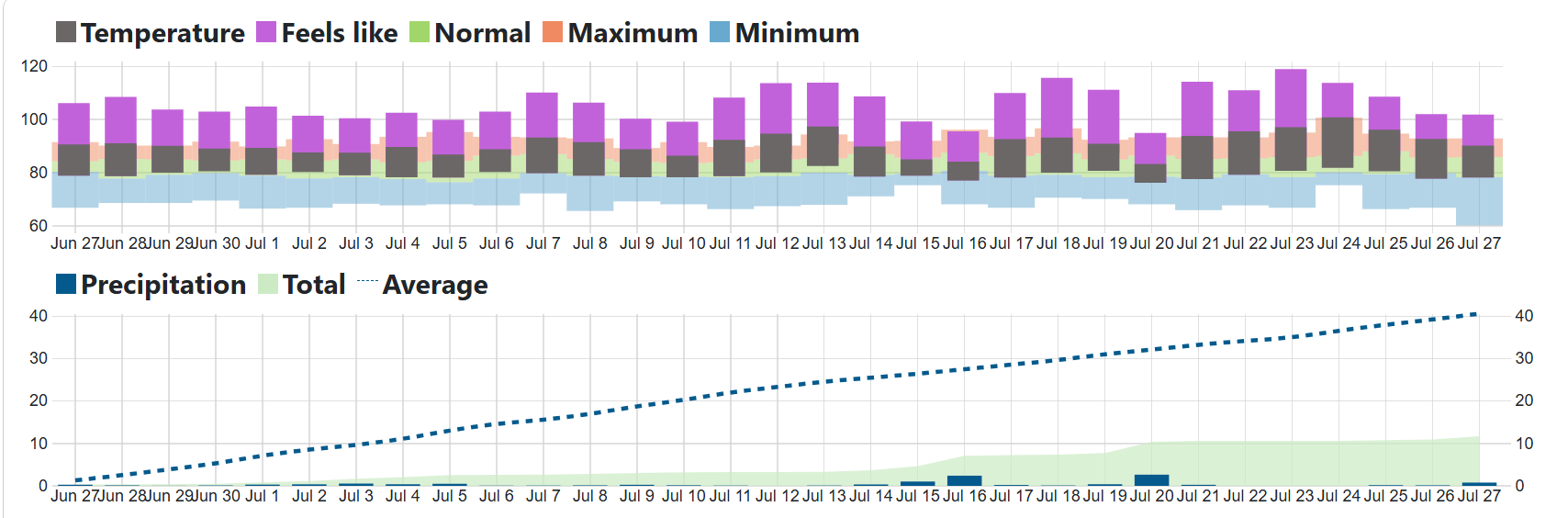
With rising temperatures, rainfall has come down drastically. Between 2010 and 2025, Siliguri has seen about 16% less rain in a year on average, while temperatures have risen by just over 1°C. That’s a steep climb in a short time—and it’s starting to show.
Siliguri is supposed to get about 3,000 mm of rain a year, most of it between June and September. July, the wettest month, alone should bring 700–800 mm, across 25 to 27 days. Where is that rain? Perhaps the data for this year is still being collating I couldn’t get the latest updates for this year. Visual Crossing reports that between July 11 and 26, Siliguri saw just about 190 mm of rain—less than a third of what’s typical for the month. The heaviest shower came on July 20, bringing around 67 mm in a single day.
Ask around. The older residents will tell you—it doesn’t rain like it used to. It’s not just nostalgia. A 2017 study based on 24 years of data showed erratic trends and inconsistent patterns in rainfall. The total volume hasn’t dropped off a cliff, but the rain seems… less committed. Shorter bursts. Longer dry spells. Fewer soaking weeks. The kind Mr. Suhas Basu talked about? Rare now.
Gone with the dust
Some of you might remember those gusts of wind that came in the afternoons of early summer—March and April, mostly. If you’re from my generation, that is. I remember how they’d accost us on our way back from school, as we walked home, one hand trying to hold down our billowing dresses, the other rubbing dust out of our eyes. At home, piles of dried leaves on the verandah would be waiting to greet us.
Ever wondered where those winds went? They had a name—pochai, or something like that. I didn’t know it back then. It was only when I did a story on it as a cub reporter for The Telegraph that I learnt what they were called.
“Pochai, you remember?” Prof Subir Sarkar of North Bengal University had said to me, speaking of the local wind that had suddenly stopped showing up. Prof Sarkar was my go-to expert for any piece I wrote on the region’s geography or climate. I do hope this blog finds its way to him. “It has been three years now, the local wind has not…”—I forget the exact quote, but it was something like that. He said this nearly 20 years ago.
I wrote a piece then on how pochai had disappeared after reigning over our early summer afternoons for so long. I don’t think I ever found an explanation. Nothing made sense. But that small change, that quiet loss, was a sign. A signal that things were shifting—and not for the better.
A town that outgrew its weather
Siliguri didn’t just grow—it sprawled. What was once edged with rice fields and bamboo thickets is now lined with malls, flyovers, petrol pumps, apartments. As the town got louder, the weather fell silent. It still rains, yes. The air gets cooler in December. But the rhythm is off. The predictability is gone.
Maybe that’s what climate change feels like in a place like this—loss, not disaster. At least not yet. But we’re running out of time to keep calling this normal.
 Anuradha Sharma