On May 1 this year, I received an invitation to attend the celebration of 139th International Labour Day at Longview Tea Estate. I wasn’t quite feeling well and there was a lot to do, but it was an opportunity I did not want to pass.
So, I joined a bunch of lively young members of the Hill Plantations Employees Union, the organisers, and squeezed into a shared Tata Magic waiting at Khaprail More. Ukeleles and guitars on our laps, we swayed to the rickety rhythm of the microvan that dropped us off at Garidhura, about 15 km away. There, we transferred ourselves into another shared cab that took us to our destination, about three kms away from there.
Longview, situated at the meeting point of the mountains and the plains, is one of the most beautiful tea estates in this part of the world. I have crossed it many times in my life, and every single time I have been fascinated by the low clouds flirting with kitchen smoke over the undulating swathes of green tea bushes in the warm, orange light of the setting sun.
It was no different on the sunny May morning. Only, more festive.
When we arrived at the venue, almost two hours late, the community hall was brimming with workers dressed in their holiday clothes. The programme was about to start. Outside, some of them were hunched over steaming hot potatoes, which they peeled with the same dexterity with which they pluck tea leaves. There’s going to be a feast!
The programme began with the unfurling of the recently adopted HPEU flag. It was a hand-painted flag, which had used up a lot of midnight oil as the members laboured on it themselves the previous night. Commercial printers only take bulk orders, and they needed only a few.
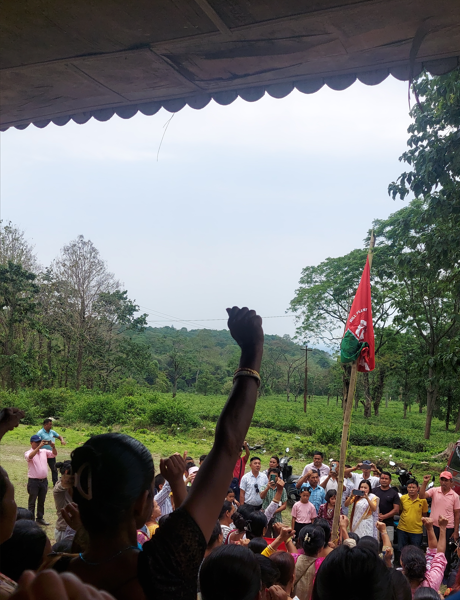
The cultural programme took off with the young HPEU leaders–some of whom I travelled with from Siliguri–setting the mood with their revolutionary songs. The bunch of talented bhai and bainis, whom I have known for quite some time now and whose idealism I have admired greatly, are mostly children of workers from various tea gardens. It’s another matter that Samikda–the fountainhead of inspiration about whom I shall not say much now (it will take a lot of space)–said in all his playful sarcasm that the musicians made all musical notes happy, with all of them singing in different pitches.
But who cared for pitches and such trivialities? It wasn’t a Broadway concert, after all. It was a day to let loose, a day to unwind. One day for the labourers and their families to revel in their own joy–a day circled on the calendar just for them. Of course, there are plenty of things to complain about, plenty of things to ask for–nothing comes to the workers without demanding–and plenty of issued to protest against. But on May 1, workers of the Longview tea estate were there to only celebrate, to celebrate the power of unity, solidarity, and collective strength.
***
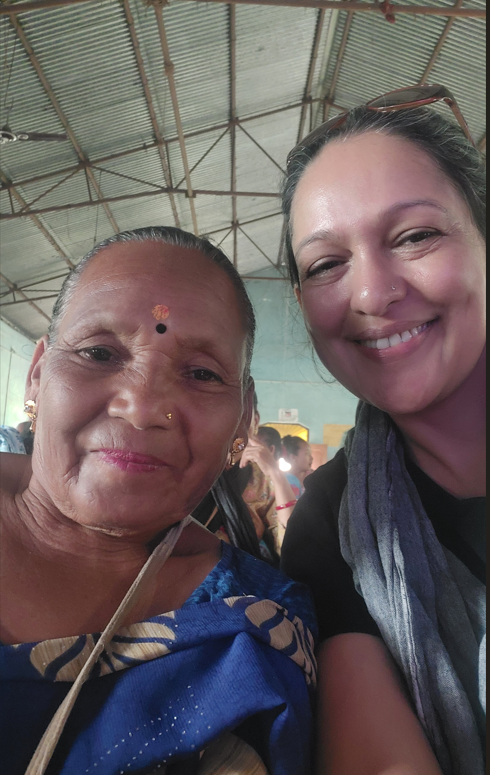
I write this post–seven days too late– for Devika Pariyar, the 62-year-old tea plucker who touched my heart. In the few hours that I spent with her, I glimpsed a life of resilience, struggle, and quiet strength that left an indelible mark on me.
Just as the programme started, she came in and sat next to me. I noticed that she was occasionally raising her hands and blowing on the palms, as if trying to dry them. “Bhat bhat poldaichha“, she said when I asked her what happened. Her fingers were on fire; she had just chopped a lot of chillies. She had been at the venue since early in the morning, lending a hand in organising the event, especially preparing lunch for the 300 or so people gathered there.
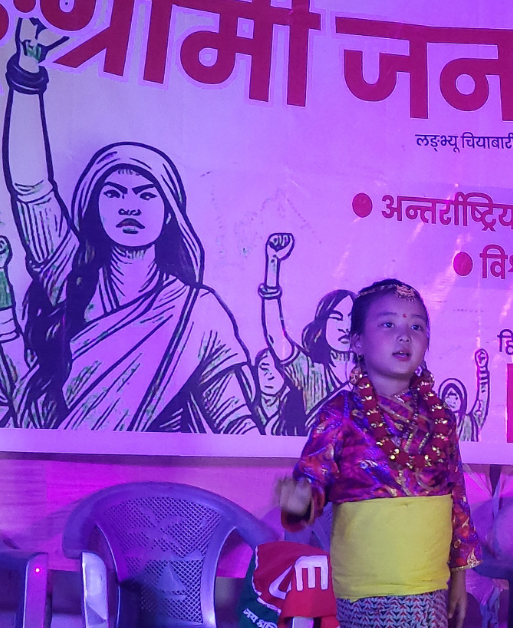
But she forgot all about the sensation in her fingers as she immersed herself in the goings-on on the stage. “These little ones are from that village,” she told me, pointing diagonally in front of her. “They have been practicing for quite some time now.”
She clapped enthusiastically, and raised her voice to chant “Jai Shramik” as vice-president Chewang Yonzon took the stage to speak about workers’ rights and the importance of labour day. He also enumerated the problems facing tea workers, dwelling upon the non-implementation of Minimum Wages Act–workers still get only Rs 250 for whole day’s work–and the threat from the recent government decision to allow 30 per cent of tea plantation land to be used for non-tea purposes.
“Two months,” Devika Pariyar said as she turned to me, sticking out her two stubby fingers. “We have not yet got our wages for the past two months.”
She has been working at Longview for over 45 years. Now, 62, she is past her retirement age, but she is still plucking tea. “They have not yet processed my papers or settled my retirement dues,” she told me. “I don’t know what’s happening.”
It is hard not to speak of the daily hardships faced by the workers, even though that day’s mood was festive and celebratory. Especially true for Longview, the estate which has been in the news for some time now for its messy disputes, shutdowns and longstanding workers’ protests. Last year, during bonus negotiations, for instance, the workers conducted a relay hunger strike demanding 20 per cent bonus. The management had shut the garden down for almost a month, and reopened it on November 11.
The grim reality of the tea sector reflected heavily on the day’s cultural events as children took to stage to speak of exploitation of workers and their struggles.
Sadri-speaking children danced to an Assamese song “Mui nai korbo pata tola kaam re” (I won’t do the job of plucking tea leaves). The lively song and dance number is very telling of a major issue facing the industry–the growing awareness among younger generations in the tea gardens. They want to break free from the cycle of exploitation going on through generations.
Inexpensive labour has been at the core of the tea sector right from the time when the British set up the industry in India. East India company banked on cheap workforce for the success of the industry, which is highly labour-intensive. The business model didn’t change after Independence. Living in the confines of labour lines of tea plantations, workers produced generations of workers, as the system perpetuated. But the workers now are not the same as they were 50, or even 20 years ago. Their children are educated. They know a better life is possible. And they want it. They demand it.
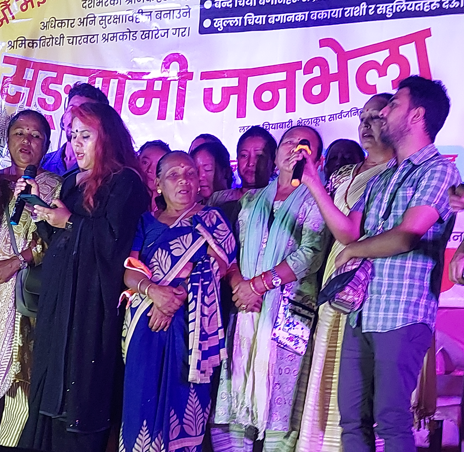
Presently, the announcer invited the senior women workers to the stage to sing. “Won’t you participate, chhema” I asked Pariyar. By this time, she had started addressing me as “chhori” (daughter) and I settled for “chhema” (aunty). “No!” she said vehemently, “I cannot sing.”
Just then, Rajani Bhusal, another senior worker whom I had interviewed last year, came in and sat down close to us. We exchanged greetings, and I was barely done when I noticed that the chair next to me was empty and Pariyar was gone. To my amazement, she was on the stage, on the front row of a group of women workers, singing a song written by Gokul Singh Thapa, a singer-songwriter and retired tea worker from Bagrakote tea estate who had passed away recently.
“I know this song by heart,” Pariyar told me later, grinning from ear to ear. “I have sung it so many times at meetings, and protests.”
***
The lunch was ready. I invited Pariyar to join me. She had had a packet of biscuit for breakfast; she must have been hungry. But just then some guests apparently wished to have coffee, which couldn’t be made at the venue. Milk and sugar in their hands, Pariyar and her neighbour set out for Pariyar’s home to prepare coffee–that was their third trip that day.
“Coffee?” I asked in disbelief. “Why would anyone want coffee at a tea event, that too when it cannot be made here at the venue where most of the cooking is being done.” As it turned out, it was only me who was complaining. Neither Pariyar nor her neighbour felt any annoyance.
“Some people prefer coffee,” Pariyar said nonchalantly. “And that’s okay.”
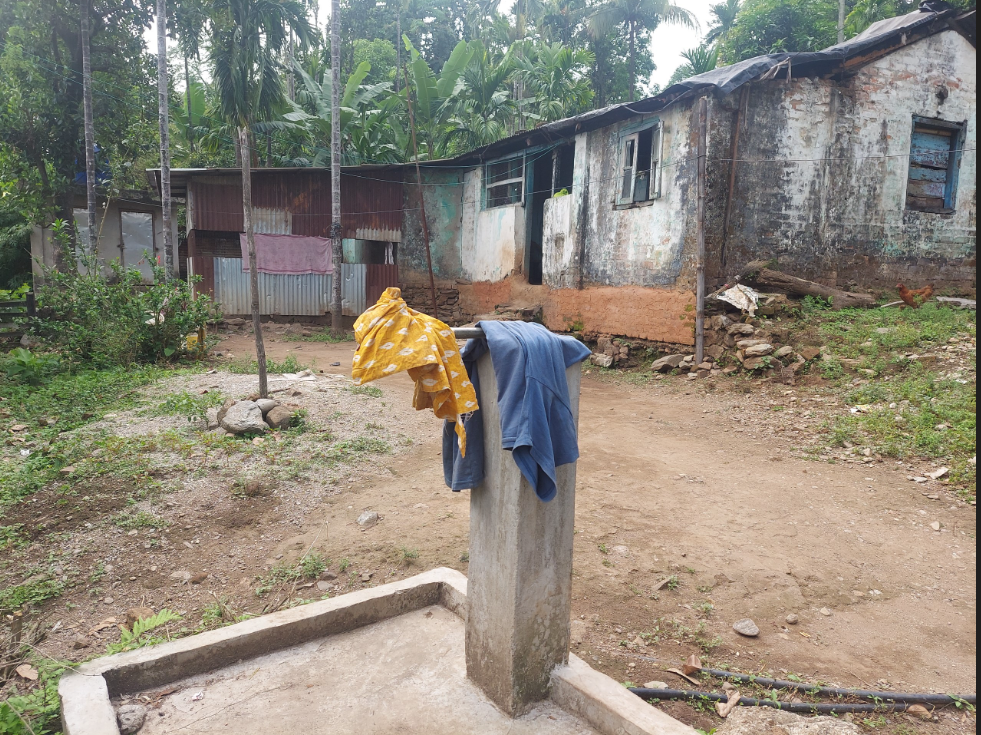
Her home, a dilapidated two-room quarter, was the place she had grown up in. This was her parents’ old home, where she had returned after her marriage ended. Now, she lived alone, her daughter married off, and her parents no longer alive. “Someday, I hope to get my house repaired,” she said. It was a tiny, crumbling house, but she had done it up with a lot of care.
The tiny kitchen, with its peeling walls and soot-covered surfaces, told a story of its own. As she poured water from a 2-litre Sprite bottle for the coffee, I noticed the absence of a functional water supply. There was a panchayat-installed tap outside, but it did not dispense any water. She relied on fetching it from a distant natural spring. The Sprite bottle was her makeshift solution, allowing her to carry water without straining herself. “I cannot carry heavy gagris or jerrycans,” she said. “Some days, when I am not able to take a long walk, I buy water.”
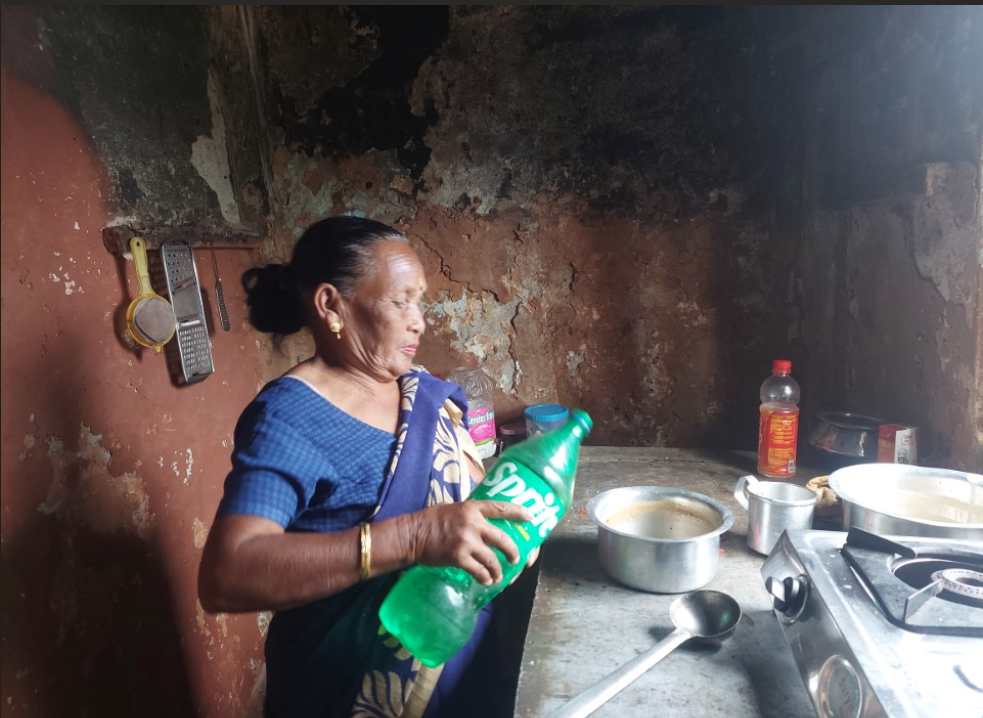
The two women struggled in turns with the lighter to get the gas stove started. “It is doing bharr bharr. You must get it repaired soon, Mailididi. It is not safe,” Pariyar’s neighbour told her as they prepared coffee. “Yeah, yeah, will do once the money comes,” she replied.
As we returned to the venue, Pariyar and her companion carried the hot coffee in a flask and kettle, while I offered to carry the leftover sugar.
I sat down to eat, but Pariyar didn’t join me. “I’m a local, I’ll eat later. The guests must eat first,” she insisted as she stood next to me to ensure I was eating well. The simple meal of rice, dal, aludam, and tomato-onion achar tasted heavenly.
Just as I was eating, someone offered me a lift back home to Siliguri. I thought of my kids waiting at home, both unwell due to viral fever. I quickly finished my food and hurried out, barely managing to say goodbye to Pariyar. As soon as the car crossed Garidhura, I felt a pang of guilt for rushing off without waiting for her to finish her lunch, for not taking her leave in a proper way.
The guilt lingered as I settled into the long drive ahead, my mind oscillating between concern for my children and regret over the abrupt departure. I couldn’t shake off the feeling that I had left Pariyar without showing the gratitude and respect she deserved.
After reaching home, I managed to get Pariyar’s phone number through someone. However, when I tried calling, I found that the number hadn’t been recharged. I quickly added a small amount to recharge it, but even after that I got the same recorded audio message. It is possibly switched off.
Here’s hoping her wages come through soon, and she’s able to switch her phone back on. And then we shall talk, chhema-chori.
 Anuradha Sharma